Everything we know about Guild Wars 3
A collection of confirmed details about Guild Wars 3, including setting, story, platforms, release window, combat, the Vaelwardens, features, and more. All information is sourced from ArenaNet's official announcements and press coverage.
The Announcement
- Announced during Summer Game Fest on 5 June 2026 - ArenaNet's first brand-new game since Guild Wars 2 in 2012.
- Framed as a "modern evolution of the MMORPG" rather than a straight sequel.
- It has been in development for around four years.
Setting and Story
Guild Wars 3 is a prequel. It takes place in the region of Orr more than a thousand years before the events of the first Guild Wars, long before the cataclysm that fans of the series associate with that land. Rather than the drowned ruins of Orr of GW2, this is a living frontier.
ArenaNet describes Orr here as a vast wilderness rich with the world's raw magic, home to nature spirits - referred to as Vael spirits - that are deeply tied to the land itself.
Narrative lead Aaron Linde has framed the era as the Orrian golden age, a mythic time when "the Elder Dragons' slumber is at its deepest point" and magic flows so freely through Orr that it draws humanity's gods out of the Mists and into Tyria.
The gods are present in this era: their high city of Arah "looms as large on the horizon as its hosts" and Orr's collapse is still over a thousand years away.
The World
- A large, seamless open world with far fewer loading screens than Guild Wars 1 or Guild Wars 2.
- Instances load without a loading screen. Playtesters have entered story missions without realising, and ArenaNet is working on signposting the transition more clearly.
- Render distance and explorable boundaries were described as colossal by press who saw it running.
- One capital city, with many smaller camps and settlements spread across the world.
- The first city players see is Warden's Watch.
- The small flying creatures from the reveal trailer are called root runners.
- The art style is sharper and less cartoony than the reveal cinematic, and reads much closer to Guild Wars 2. ArenaNet says it is happy with where the look has landed and does not expect it to shift much further.
- Colin Johanson says Guild Wars 3 should look distinct the way Guild Wars 1 and 2 differ from each other, but that it has to feel like Guild Wars.
- Scale, lighting, weather effects, draw distance, and verticality were all singled out as standouts by press.
- The team is mindful that not everyone has a high-end PC.
Movement
- Confirmed movement options: walking, running, jumping, wall running, ledge climbing, climbing, sliding, gliding, and mount movement.
- Everything flows into everything else - gliding into a wall transitions straight into a wall run, with no landing in between.
- Momentum is carried rather than lost. Speed going into a wall is kept when transitioning (seamlessly) into a wall run.
- Movement feeds damage: the faster you move and the higher you jump, the harder the attack that follows lands, and the wider its area of effect.
- Fall damage applies to players and NPCs alike, and NPCs can take environmental damage.
- ArenaNet has had ideas like this since around 2015, but they were not practical within Guild Wars 2's technology - one of the major reasons for making Guild Wars 3.
Combat
- Action combat built around momentum, blended with the build-crafting the series is known for, and designed to feel equally at home on controller and on mouse and keyboard.
- A lock-on camera with soft-lock targeting: it picks the enemy you are facing and moves to the next as you turn, with a separate keybind to choose a target yourself.
- No precision aiming. Every playable species shares the same hitbox, so millimetre-accurate aiming was never on the table. Ranged attacks still need pointing roughly the right way, and can be obstructed or fall out of range.
- Enemies have weak points, compared by press to Monster Hunter - hitting the right spot matters, not just hitting the enemy.
- Other enemies are countered through your build instead. Burning clears a spider's webs; a heavily armoured mini-boss explodes if you set the flamethrower tank on its back alight.
- Terrain is a weapon. Knock enemies into walls to stagger them, or off ledges to kill them with the fall.
- The physical size of an opponent plays a role in how easily it can be stunned or staggered.
- Conditions are confirmed, but there is no icon spam. They are visible as effects on the models themselves - a sword on fire, an enemy encased in ice.
- Status effects stack visibly: repeated chill slows you further and further until you freeze solid, and a fire attack thaws a frozen ally.
- Bosses are not immune to conditions or crowd control, so encounters are not meant to be tank-and-spank.
- An expanded combo system, working differently from Guild Wars 2's fields and finishers. Combos come from interacting with another player's abilities - a warrior jumping through a ranger's ice attack to freeze enemies, or an ally launched off a raised shield for a momentum-boosted strike.
- ArenaNet is deliberately letting players push these interactions. Permanently freezing a boss, or building for knockbacks to shove the strongest foes off a cliff, is treated as a feature rather than a bug.
- Underwater combat is something ArenaNet says it will talk about soon.
User Interface
- A much less cluttered UI than Guild Wars 2, and ArenaNet wants to strip it back further still.
- No boon or condition icon spam - those states are read visually off characters and enemies instead.
- A stamina bar is confirmed.
- The build shown to press had a health bar, three abilities, and what looked like three consumable slots. ArenaNet stressed it is a work in progress and that the stamina display had already changed since.
- Characters were using more abilities than the bar accounted for, so three is not the final skill count.
- The minimal approach came from designing for console - you cannot hover over icons with a controller on a couch. The team found it improved mouse and keyboard play too.
- Expect more UI by launch than press saw, but keeping it minimal remains a pillar.
Playable Races / Species
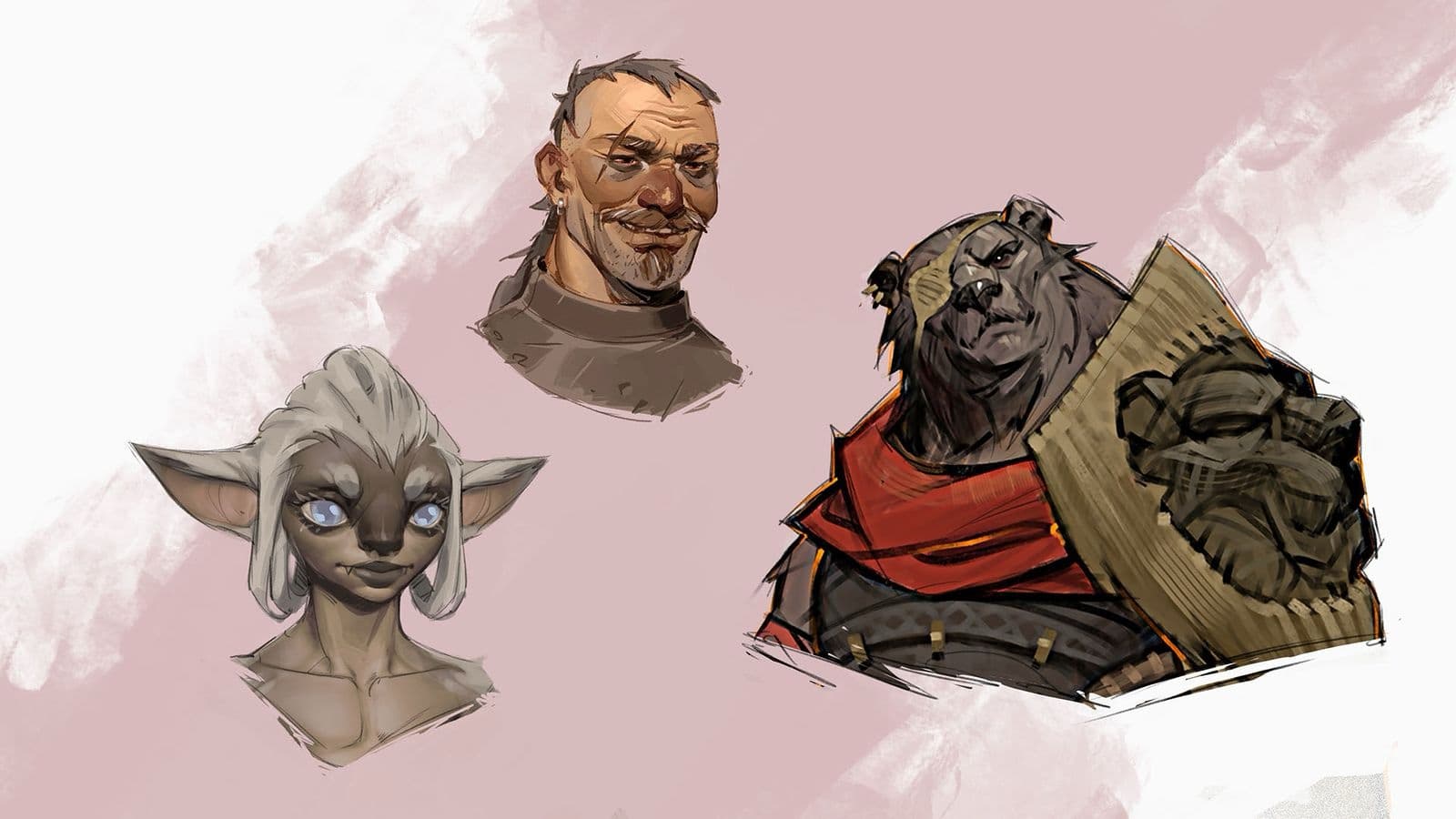
- Four playable species at launch. Two return from earlier games - Humans and Asura. The third is the Kodan, ArenaNet's "awesome bear people", playable for the first time. The fourth is described as a species "whose story connects deeply to Orr's past but has been lost to history", and is still secret.
- ArenaNet is not naming the fourth species yet. Press came away with a hint that something akin to the sylvari may appear, though it is unclear whether that is it.
- ArenaNet has dropped "playable races" in favour of "playable species", saying the old wording "didn't accurately describe the biological differences between the peoples of Tyria".
- Choice is purely cosmetic or to define player identity. It grants no gameplay advantages - no stat differences, racial abilities, or even hitbox differences.
- More species are intended to follow after launch. Some too far from a human form have been ruled out, such as the four-armed Forgotten.
- Humans: brought to Tyria from a realm beyond the Mists by their six gods, and resident for over 700 years.
- Kodan: originally from the Far Shiverpeaks, a group migrated to Orr over a century ago, called by their god Koda to protect the land. They allied with the Vaelwardens, and playable kodan are members of that order.
- Asura: first reached Orr around 300 BE, drawn to its raw magic, and run the surface outpost of Rata Pten near Criterion Canyon. These early-era asura are a little taller and furrier than their GW2 descendants, and the Vaelwardens eventually taught them signet artificing.
Professions and Classes
- Three professions named so far: Warrior, Ranger, and Necromancer. The rest of the roster is unknown.
- The holy trinity is in - tank, healer, and DPS - though roles stay relatively flexible depending on the profession you pick. Colin Johanson frames it as a step back towards Guild Wars 1.
- The ranger was described as able to tank and deal damage.
- Every profession gets an elite skill, charged in its own way. The warrior fills a gauge through movement, then enters a berserk state with higher attack speed and fire attacks. Others might charge theirs by jumping or dodging.
- Professions have distinct mechanics: the warrior can infuse allies with fire, the necromancer fires projectiles from a scythe, and the ranger has an ice attack the warrior can combo through.
- Classes are built to interact. Synergies and cross-class combos are a core part of group play.
- Mesmer was raised with the developers, who said they were not ready to talk about it rather than denying it. Not a confirmation.
- Skills, abilities, and the full roster are still to be detailed.
Weapons
- Confirmed so far: sword, shield, bow, and scythe.
- Weapons carry their own special abilities on top of their normal skills. The shield shown lets an ally walk into your block and be launched into the air for a heavy landing attack, and different shields are expected to do different things.
- No weapon swapping was visible in the build shown to press.
Signets
Signets are described as small gems that each hold a fixed expression of magic. The Order of the Vael was the first among mortals granted the power to create them, a gift tied to the divine support of Melandru and Dwayna.
Over the order's history signets spread far beyond the order itself, becoming commodities that were bought, sold, and traded on the black market.
The Player
It is unsure what role the player will take in the story, but early lore drops hint at the player not being the hero of the story (unlike in GW2): "you are not a chosen one, anointed by destiny to save the world—you are the last of an order that the world has written off"
Guild Wars 2's per-race divergent openings look unlikely to return. ArenaNet did not answer directly when asked, but pointed to how expensive that structure made adding or changing a race. A simpler start is expected, possibly beginning at the point where you become a Vaelwarden.
The Vael
- The Vael are magical spirits unique to this period of Orr's history, described as "a wondrous ecosystem of magical spirits" that flourished across the land while the Elder Dragons slept.
- In dark places you can use a spirit to light up the area around you, like a torch.
- Enemies can use spirits too.
The Vaelwardens
Players take on the role of a Vaelwarden, a member of an order of adventurers sworn to safeguard both the wild spirits of Orr and the land they inhabit. The Vaelwardens are positioned as the central faction of the game and the lens through which you experience its world.
Also called the Order of the Vael, they are the oldest guild in Orr, founded to protect the Vael spirits and the lands they inhabit. Long before the other guilds rose, they were mediating relations between Orr's sentient species and the Vael. Its founding members earned the support of the goddesses Melandru and Dwayna, who granted them the use of magic through sigils.
ArenaNet frames the present day of the game as a low point for the order. By the time players take up the mantle, the order has been pushed to the margins and is widely dismissed as "aloof zealots clinging to a cause that died decades ago.
The Mavenwrights
The Mavenwrights are introduced as a rival faction representing Orr's industrial interests. They oppose the order's preservation efforts, viewing the magical wilds and the Vael as resources to be exploited.
They see in Orr's magic "the possibility of a better, stronger future built with human hands", "stone and steel, signets and artifacts".
Founded just over twenty years before the game begins by Ricken "the Hammer" Oberon of Callen's Way, a small settlement on a mercantile low road. The guild was originally chartered by Orr's High Council as a crafters' guild, until a verdict from the gods cut it off from signet artificing.
Now outlaws, they deal signets under the table, steal resources from settlements and the Vael, and increasingly turn to open banditry. Their home-made magical weapons can hold only a single signet, and their burners wield flamethrowers each powered by a captured Vael sprite.
Most Mavenwrights are human, but other species do sometimes join.
The Seeker
Every player is paired with a Seeker, a spirit-bonded companion that doubles as a mount. Beyond carrying you across the open world, the Seeker is described as your personal connection to Orr's wild spirits, tying traversal and the game's spiritual themes together.
ArenaNet has since described Seekers as spirit companions the player deepens their relationship with over the course of the game.
Multiplayer and Group Content
- Guild Wars 3 sits between its predecessors on scale: not fully instanced like Guild Wars 1, not hundreds-strong like Guild Wars 2. It is a true open world MMO where you run into players you do not know, at a smaller moment-to-moment scale.
- ArenaNet calls the philosophy a "meaningful multiplayer online RPG" - the goal is not to put as many players on screen as possible, but to make interacting with them improve the experience.
- Roughly 20 players is the cap in active combat areas of the open world - the point at which ArenaNet thinks combat stops being visually readable. It is still being tuned.
- Social hubs - cities and towns - scale up significantly higher.
- The open world uses a phasing system to decide which players you see, built so you are constantly running into others rather than sharing a fixed 20-player server.
- Parties are four players at launch.
- Group content maxes out at 20 players.
- Crossplay is confirmed. Nothing has been said about cross-save.
- Dungeon and raid-type content is coming, described as "high-trust coordinated dungeon-like experiences".
- ArenaNet says it is already building endgame bosses designed around these combat mechanics.
- Boss difficulty scales with the number of players taking part.
- No Guild Wars 2 style mass meta events. ArenaNet hinted instead at events split into pockets of players spread across an area.
- PvP is confirmed, but World vs World is not coming. Large-scale PvP is being left to Guild Wars 2, where the combat suits it.
- On esports, ArenaNet stopped short of committing, but said it would not mind supporting competitive play if the community engages with it.
Fashion and Customisation
- Fashion plays a bigger role than it does in Guild Wars 2.
- Deep character customisation and build-crafting through skills remain core to how a Vaelwarden grows.
Design Goals
- ArenaNet develops around "player problems". Guild Wars 2 tackled other players making an MMO worse - kill stealing, contested quests and nodes. Guild Wars 3 asks whether strangers can actively make the game better.
- Immersion is a second pillar: fewer of the things that remind you that you are playing a video game - UI everywhere, loading screens, how story is told.
- Time is the third. Johanson calls "I don't have time for that" the number one problem the genre faces, and wants players to press a button, get their build, and meaningfully accomplish something on a lunch break.
- ArenaNet is deliberately future-proofing, designing systems while asking what happens if the game is still running in 5, 10, 20, or even 40 years. Guild Wars 1 was not built around a long-term post-launch strategy, and Guild Wars 2's live-service approach shifted repeatedly over its lifetime.
- The studio also wants enough depth for players who put hundreds or thousands of hours in, not just the lunch-break case.
- More player problems are being held back for now, particularly around social and communal play.
Release and Platforms
- Confirmed for PC (including Steam) and PlayStation 5. Only those two platforms are being considered at this stage.
- The first Guild Wars game built for home consoles, which is why the combat is designed around controllers.
- A physical collector's edition is confirmed.
- The first beta test is scheduled for fall 2027.
- No full release date yet. ArenaNet has said it will share beta details, pricing, and timing across late 2026 and into 2027.
- NCSoft hinted at a Q2 2028 release date (or earlier) in its Q2 2026 earnings call, because of a loan coming due at that time.
Engine
- Built in Unreal Engine 5, with ArenaNet emphasising large-scale open-world exploration, dynamic combat, and a world that reacts to player choices.
- Colin Johanson framed the goal as an online world that feels believable, rewarding, responsive, and innovative while still respecting players' time.
What happens to Guild Wars 2
ArenaNet has been explicit that Guild Wars 3 is not the end of Guild Wars 2. The studio stated it is committing to actively developing three games at once: Guild Wars Reforged, Guild Wars 2, and Guild Wars 3.
ArenaNet says Guild Wars 2 will continue for as long as people want to play it, including continued updates and expansions. Guild Wars 3 does not have to replace everything Guild Wars 2 does - World vs World stays a Guild Wars 2 feature.
Sources
- ArenaNet - The Vaelwardens of the Orrian Golden Age
- ArenaNet - Our Approach to Playable Species in Guild Wars 3
- ArenaNet - Playable Species Spotlight: Humans
- ArenaNet - Playable Species Spotlight: Kodan
- ArenaNet - Playable Species Spotlight: Asura
- ArenaNet - Meet the Mavenwrights
- ArenaNet - Celebrating the Announcement of Guild Wars 3
- Official press release (PR Newswire)
- Massively Overpowered - Everything we know about Guild Wars 3
- Guild Wars 2 Wiki - Guild Wars 3
- NCSoft Q2 2026 Earnings Call
- JayOddity - Hands-off demo impressions (Reddit)
- JayOddity - Guild Wars 3 Gameplay Just Changed MMOs FOREVER (YouTube)
- Syrma Gaming - Everything NEW We Know About Guild Wars 3 From Gamescom (YouTube)